


The Tiny Molecular Timekeeper
Some of the most important revolutions in science begin with something too small to see. The 16S rRNA gene is one such revolution in miniature: a short stretch of bacterial and archaeal DNA that has transformed the way microbiologists identify, classify, and understand the invisible majority of life.
It is not a gene that makes a dramatic entrance. It does not produce a toxin, glow under ultraviolet light, or announce its presence with the theatrical confidence of a pathogen. Instead, it encodes a component of the ribosome—the molecular machine responsible for building proteins. Yet, because the gene changes slowly over evolutionary time while retaining enough variation to distinguish different organisms, it has become a kind of biological passport.
In a world where microbes outnumber human cells in astonishing abundance and inhabit nearly every surface, the 16S rRNA gene offers a practical way to ask a deceptively difficult question: who is actually there?
What does “16S rRNA” mean?
The name sounds like a password invented by a particularly joyless computer. It is, however, fairly logical.
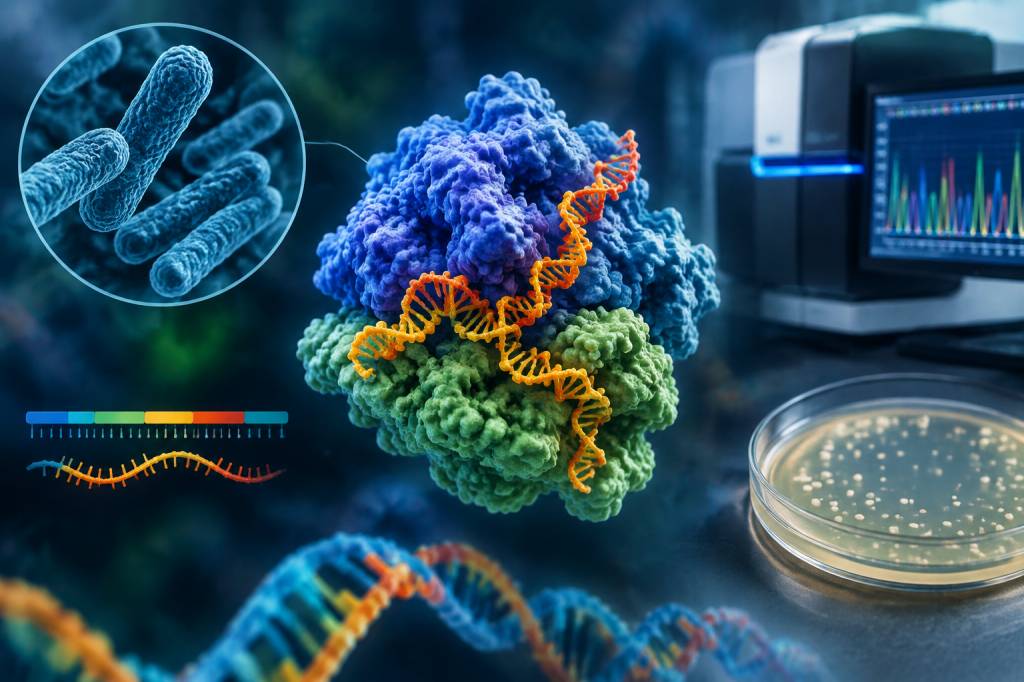
“16S” refers to the sedimentation coefficient of the small subunit of the prokaryotic ribosome. The “S” stands for Svedberg unit, which describes how quickly a particle settles during ultracentrifugation. The small ribosomal subunit in bacteria and archaea is known as the 30S subunit, and its principal RNA component is 16S ribosomal RNA, or 16S rRNA.
The 16S rRNA gene, often written as rrs or rRNA, contains the DNA instructions for producing this RNA molecule. In bacteria, it is usually found alongside the genes encoding the other ribosomal RNA components, although the precise arrangement can vary between organisms.
Ribosomes read messenger RNA and assemble amino acids into proteins. Without them, a cell would possess genetic information but no practical way to turn that information into the machinery of life. The 16S rRNA molecule helps form the architecture of the small ribosomal subunit and contributes to the accurate pairing between messenger RNA and transfer RNA.
In other words, the gene is both essential and ancient. That combination is microbiological gold.
A structure built for both stability and change
The 16S rRNA molecule is approximately 1,500 nucleotides long in most bacteria and archaea. Its structure contains regions that are highly conserved across large groups of prokaryotes, alongside variable regions that differ between lineages.
This unusual mixture is the source of its usefulness. The conserved regions act like landmarks. They allow researchers to design “universal” primers that can bind to the 16S rRNA gene in many different bacterial and archaeal species. The variable regions, meanwhile, provide the distinguishing features needed to separate one microbial group from another.
The gene is commonly divided into nine variable regions, named V1 through V9. These regions are interspersed with conserved segments. Different sequencing strategies target different combinations of these regions:
- V1–V2 may provide strong resolution for certain microbial communities.
- V3–V4 is widely used in environmental and gut microbiome studies.
- V4 alone is popular because it offers a useful balance between informative variation and manageable read length.
- Near-full-length sequencing can cover most or all of the gene, potentially improving taxonomic identification.
There is no universally perfect region. Microbial evolution, experimental design, sequencing technology, and the database used for comparison all influence the result. Choosing a primer set is less like selecting a magic key and more like choosing the right lens for a foggy landscape.
Why the 16S rRNA gene works as a microbial marker
A useful genetic marker must satisfy several conditions. It should be present in the organisms being studied, perform an important biological function, contain enough conserved sequence for reliable amplification, and also include variation that reflects evolutionary relationships.
The 16S rRNA gene meets these requirements remarkably well.
Because ribosomes are essential, the gene is found across bacteria and archaea. Its core function places evolutionary constraints on much of the sequence, reducing the likelihood of rapid, random change. At the same time, certain exposed or less functionally restricted regions can accumulate substitutions over generations.
This makes the gene suitable for constructing phylogenetic trees—diagrams that estimate how organisms are related. The approach was famously advanced by Carl Woese, whose work in the late twentieth century used ribosomal RNA comparisons to reveal that archaea form a distinct domain of life rather than being merely unusual bacteria. A few thousand nucleotides helped redraw the map of biology. Cartographers of the microscopic world, take note.
The 16S rRNA gene is especially valuable when researchers do not know which organisms are present in advance. Traditional microbiology often relies on growing microbes in the laboratory, but many environmental organisms resist cultivation. They may require precise nutrients, unusual temperatures, specific partners, or conditions that no human-made flask has successfully imitated.
Sequencing the 16S rRNA gene makes it possible to study microbial DNA directly from soil, seawater, sediment, food, wastewater, or the human body.
From sample to sequence
A typical 16S rRNA analysis follows a chain of laboratory and computational steps. Each one matters. A mistake at the beginning can travel quietly through the entire process, wearing the respectable costume of scientific data.
- Sample collection: Researchers collect material from a chosen environment, such as a soil core, water sample, oral swab, or intestinal specimen.
- DNA extraction: Total DNA is isolated from the sample. The extraction method must break open the relevant cells without excessively damaging the genetic material.
- PCR amplification: Polymerase chain reaction is used to copy a selected region of the 16S rRNA gene. Primers bind to conserved regions surrounding the target segment.
- Sequencing: The amplified DNA is read using a platform such as Illumina short-read sequencing, Oxford Nanopore sequencing, or another technology.
- Quality control: Low-quality reads, contaminants, chimeric sequences, and technical artefacts are identified and removed.
- Taxonomic assignment: The resulting sequences are compared with reference databases to estimate the identity of the organisms present.
- Community analysis: Researchers compare microbial diversity, relative abundance, and community composition between samples or conditions.
Modern analysis may use exact amplicon sequence variants, often called ASVs, rather than clustering sequences into broader operational taxonomic units. ASVs can preserve fine-scale sequence differences and improve reproducibility between studies, although they do not eliminate the deeper limitations of the marker itself.
What can 16S sequencing reveal?
Its applications stretch from Antarctic ice to intensive care wards. In environmental microbiology, 16S analysis can reveal how microbial communities respond to pollution, drought, rising temperatures, fertilizer use, or oil contamination.
In agriculture, researchers use it to study soil health and the microbes associated with plant roots. Certain microbial communities may support nutrient cycling, suppress plant pathogens, or help crops tolerate stress. A handful of soil may contain a social network more intricate than many cities, though with fewer parking disputes.
In marine science, 16S sequencing helps map bacteria and archaea involved in carbon cycling, nitrogen transformation, and the breakdown of organic matter. These invisible communities influence ocean productivity and climate processes, even though they rarely receive invitations to international summits.
In medicine, the technique has been used to investigate the human microbiome. Researchers study microbial communities in the gut, mouth, skin, respiratory tract, and reproductive system. Such work has generated important insights into associations between microbial composition and conditions including inflammatory bowel disease, obesity, dental disease, and hospital-acquired infections.
However, an association is not proof of causation. Finding that a microbial group is more abundant in people with a disease does not demonstrate that it caused the disease. It might be a consequence of inflammation, medication, diet, or another environmental change. Biology is fond of tangled explanations; it rarely leaves a neat confession on the table.
Culture-independent microbiology
One of the great strengths of 16S rRNA sequencing is that it bypasses the need to culture every organism. This matters because laboratory culture favours microbes that tolerate laboratory conditions. The organisms that grow readily on a petri dish are not necessarily the most abundant, important, or representative members of a community.
Culture-independent methods have revealed vast numbers of organisms that had previously been overlooked. They have also shown that microbial communities are often highly diverse, dynamic, and context-dependent.
Consider the human gut. A single sample may contain hundreds of bacterial lineages, many of which interact through competition, cooperation, chemical signalling, and the exchange of metabolic products. A shift in diet can alter the balance. So can antibiotics, illness, travel, age, or stress. The gut is not simply a container with bacteria inside it; it is an ecosystem with a remarkably personal weather system.
The limits of the molecular passport
The 16S rRNA gene is powerful, but it is not omniscient. Its resolution is sometimes insufficient to distinguish closely related species. In certain groups, even strains with very different behaviours may possess nearly identical 16S sequences.
This creates a serious issue in clinical microbiology. Two strains may share a similar 16S sequence while differing in antibiotic resistance, toxin production, or disease-causing potential. For patient diagnosis, whole-genome sequencing, targeted resistance-gene testing, mass spectrometry, or culture-based methods may be necessary.
Other limitations include:
- PCR bias: Primers may amplify some organisms more efficiently than others.
- Copy-number variation: Different microbes can carry different numbers of 16S rRNA gene copies, complicating estimates of relative abundance.
- Database quality: Incorrect or incomplete reference sequences can produce misleading taxonomic assignments.
- Dead-cell DNA: Sequencing may detect DNA from organisms that are no longer alive.
- Relative abundance: An increase in one group can make another appear to decrease, even if its absolute number has not changed.
- Contamination: Reagents, laboratory surfaces, and collection equipment can introduce DNA, especially into low-biomass samples.
For these reasons, 16S data should be interpreted as evidence rather than prophecy. The sequence offers a map, but maps do not describe every mountain, swamp, or suspiciously missing bridge.
16S rRNA compared with other approaches
Researchers now have several ways to investigate microbial communities. Shotgun metagenomic sequencing reads all the DNA in a sample rather than targeting one marker gene. It can provide information about functional genes, antibiotic resistance, viruses, and microbial genomes, but it is typically more expensive and computationally demanding.
Metatranscriptomics examines RNA transcripts and can indicate which genes are active. Metaproteomics studies the proteins actually produced. Metabolomics measures the chemical products of microbial and host activity.
These methods answer different questions. 16S sequencing is mainly designed to address microbial composition and evolutionary identity. It can suggest what organisms are present, but it usually cannot reliably tell us what every organism is doing.
A sensible study may combine methods: 16S sequencing for broad community profiling, culture for isolating living organisms, shotgun metagenomics for functional potential, and chemical analysis for observing biological activity. No single technique can interrogate an ecosystem from every angle. Even science, occasionally, must work in a team.
Why this gene still matters
The continuing importance of the 16S rRNA gene lies in its balance of accessibility and biological meaning. It is comparatively affordable, supported by extensive reference databases, and adaptable to samples ranging from ancient sediments to modern hospitals.
Its greatest contribution may be conceptual. The gene has helped microbiology move away from a narrow focus on organisms that grow easily in culture. It has made microbial communities visible as communities—complex living assemblages rather than isolated names in glass tubes.
Every 16S sequence is a small record of evolutionary history. It carries traces of ancient divergences, ecological adaptation, and the stubborn continuity of life. In a droplet of seawater or a pinch of soil, the gene offers a way to listen to an immense biological conversation, most of it taking place without witnesses.
That conversation is not always easy to translate. The alphabet is molecular, the grammar evolutionary, and the meaning dependent on context. Yet with careful sampling, rigorous controls, and humility about what the data can actually say, 16S rRNA sequencing remains one of microbiology’s most reliable windows into the unseen world.